
1976 marked the 200th anniversary of the United States. The quarter, half dollar, and dollar received Bicentennial designs with the dual date 1776–1976.
The Lincoln cent did not.
The 1976 penny kept the standard Lincoln Memorial reverse used since 1959. No dual date. No special symbol.
Many assume all 1976 coins were redesigned. That is incorrect. The cent remained a regular circulation issue.
If it was not a commemorative coin, is it worth searching for?
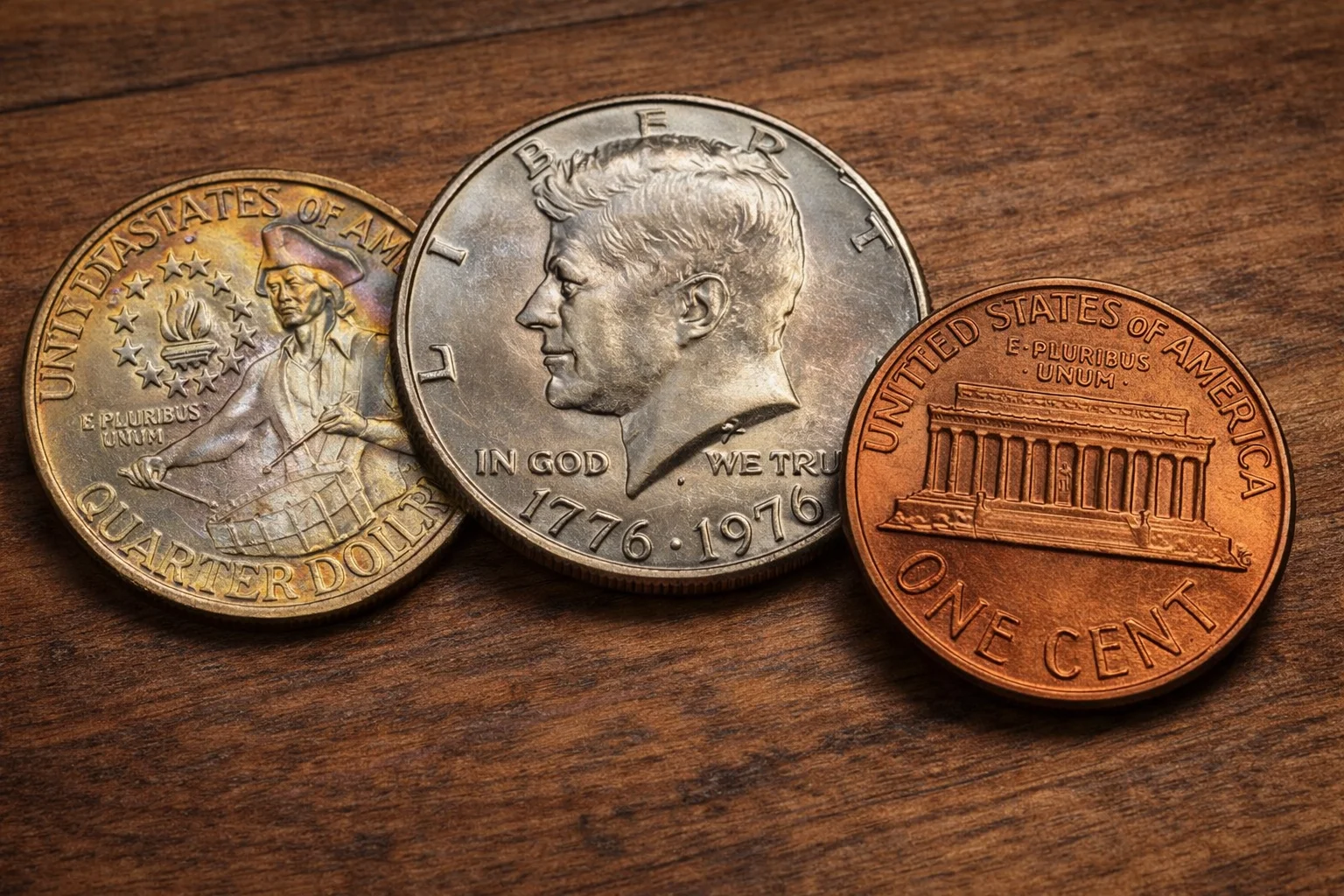
The 1976 cent is part of the Lincoln Memorial series struck from 1959 to 2008. The obverse shows Abraham Lincoln, while the reverse - the Lincoln Memorial. The design was unchanged in 1976.
Please check the table below to see the basic characteristics of the 1976 issue:
Feature | Details |
Series | Lincoln Memorial (1959–2008) |
Composition | 95% copper, 5% zinc |
Weight | 3.11 grams |
Diameter | 19 mm |
Edge | Plain |
Design | Lincoln / Lincoln Memorial |
Mints | Philadelphia produced a 1976 penny no mint mark for regular circulation |
Denver / D mark for mass use also | |
San Francisco/ S mark, proof only |
These coins contain significantly more copper than post-1982 issues. That metal profile makes them heavier and more durable.
Collectors often prefer this period because the coins feel solid. The surfaces age differently from zinc cents. Copper develops brown or red-brown toning over time.
The copper content does not automatically create high value. However, it makes these cents part of a distinct era in U.S. coinage.
Production numbers were very high. Billions were struck for daily circulation. These coins were made for everyday transactions, not as commemoratives.
Mint | Mintage |
Philadelphia | approx. 4.6 billion |
Denver | approx. 4.2 billion |
San Francisco (Proof) | approx. 4 million |
More than eight billion business strikes were produced. That figure alone defines its availability. The 1976 cent is a regular copper Memorial issue from a milestone year. It follows the same format as other cents of the 1970s.
Circulated examples are available. They appear in bank rolls, old jars, inherited boxes, and mixed world lots. Even uncirculated rolls are still found in original packaging.
Proof coins from San Francisco exist in large numbers as well. They were sold in official sets and preserved by collectors.
Taking all the above, you see: carcity does not drive the 1976 penny market. Condition and errors determine interest.
Most examples trade at face value. Still, certain categories draw attention.
Uncirculated pieces graded MS65 Red (RD) and above can command premiums. The market favors coins with:
Full original red color
No carbon spots
Sharp Memorial details
Clean cheek and jawline on Lincoln
Color classification matters:
RD (Red): full mint luster
RB (Red-Brown): partial toning
BN (Brown): fully toned
Only strong Red examples in higher grades attract serious bids. Common circulated brown coins remain inexpensive.
Error coins offer the strongest opportunity for added value. The following categories are of interest:
Doubled Die (DDO / DDR)
Noticeable doubling may appear on the obverse or reverse. Some 1976-D coins show doubling in reverse lettering, including “E Pluribus Unum.” Clear separation between letters increases desirability. Minor machine doubling does not count.
Collectors look for true hub doubling with distinct outlines.
Off-Center Strikes
These occur when the blank is misaligned in the press. Part of the design is missing. The percentage of shift determines the value.
A small 5% shift has limited appeal. A 40%–60% shift with a visible date can bring strong interest.
Coins without a visible date lose value.
Wrong Planchet Errors
A 1976 penny struck on a different blank is rare. Examples include:
Struck on a dime planchet
Struck on a foreign planchet
These pieces show different diameters, weights, and metal compositions. The strike often appears incomplete due to size differences.
Authentication is essential in such cases.
Die Breaks (Cuds)
Cuds appear as raised blobs of metal. They form when part of the die breaks away.
On 1976 cents, cuds may appear along the rim or above Lincoln’s head. Large breaks attract collectors. Small cracks are common and less valuable.
The larger and more dramatic the break, the stronger the interest.
Struck on Thin Planchet
The standard weight is 3.11 grams. A coin weighing around 1.66 grams may indicate a thin planchet error.
Such pieces look slightly thinner. Details may appear sharper due to metal flow differences.
Precise weighing is critical.
Evaluation should follow a structured approach.
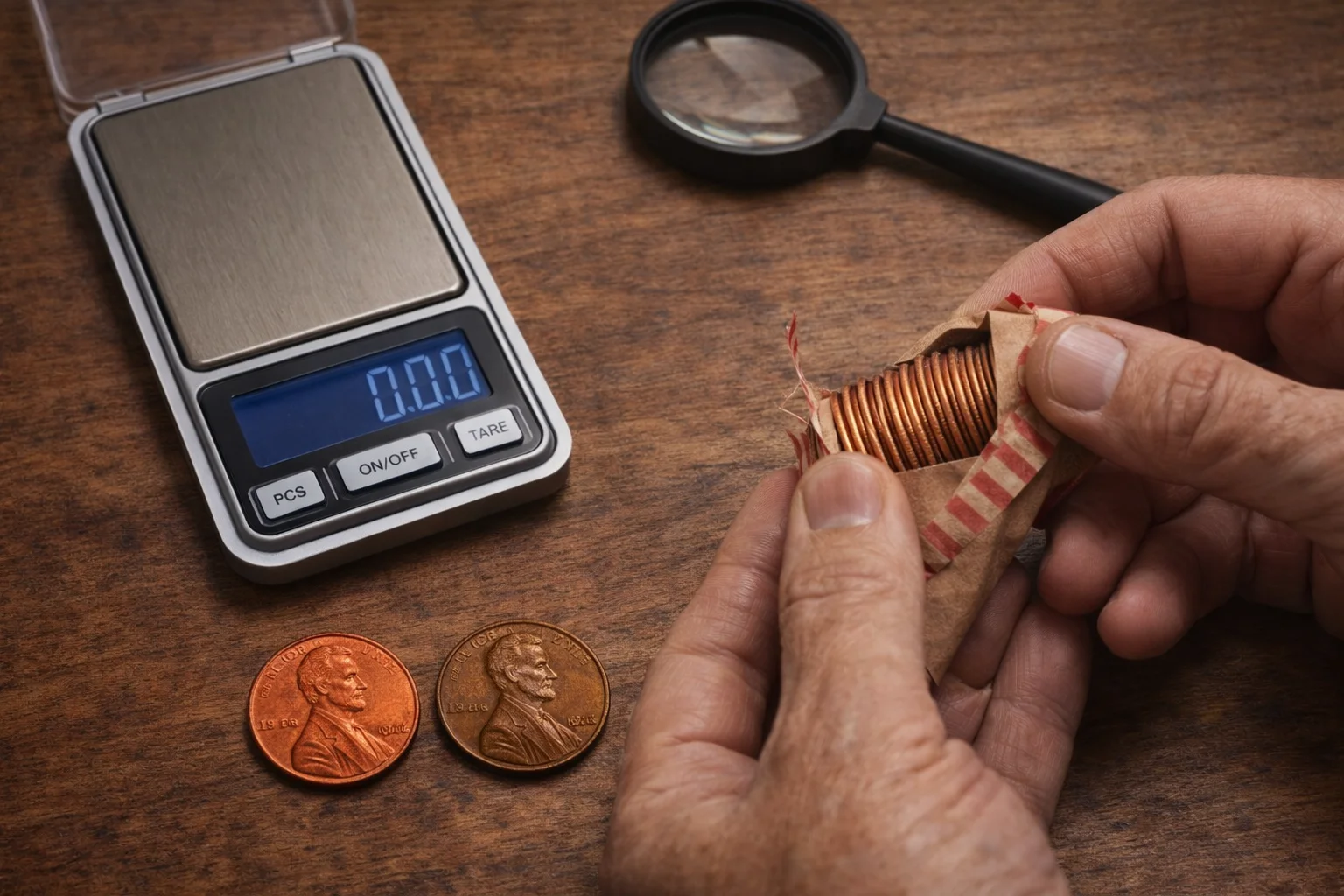
Check the weight. Use a digital scale. Standard is 3.11 g.
Inspect the color. Identify RD, RB, or BN.
Examine Lincoln’s cheek. High points show wear first.
Look at Memorial steps. Weak or missing steps may indicate strike issues.
Inspect the rim. Search for cuds or breaks.
Check alignment. Look for off-center placement.
Study lettering. Watch for true doubled die signs.
Also, remember that lighting matters. Use soft, even light. Avoid glare. Rotate the coin to reveal the relief.
For quick verification of parameters, such as composition, diameter, weight, and general price range, Coin ID Scanner can provide a structured coin card from a clear photo. It helps confirm baseline details before deeper manual inspection.
Manual analysis remains essential. A loupe and scale provide final confirmation.
Prices vary by condition and error type.
Circulated BN examples: face value.
Clean RB pieces: slight premium.
High-grade RD (MS65+): noticeable collector interest.
Dramatic off-center errors: strong market activity.
Verified wrong planchet strikes: significant premiums.
Auction results show that certified high-grade Red examples outperform average pieces. Error coins outperform regular strikes.
Proof coins from San Francisco sell steadily but remain accessible.
Supply remains strong. Demand depends on quality.
The 1976 penny does not carry the same attention as certain earlier 1970s varieties. It lacks widely recognized major doubled dies.
It belongs to a stable production year without dramatic mint changes.
Its role in a collection is often type-based. It fills the Memorial slot for 1976.
Collectors building date sets include it automatically. Variety hunters search for it selectively.
The 1976 Lincoln cent is not rare because of the year. It is not a Bicentennial commemorative piece.
It becomes interesting in specific conditions:
High-grade Red preservation
Clear doubled die features
Major off-center strike
Wrong planchet strike
Large cud error
Thin planchet weight anomaly
For routine circulation finds, it remains common.
For focused error hunting or high-grade set building, it deserves inspection.
The coin represents the solid copper era of U.S. cent production. It fills its place in Memorial collections. Its real appeal lies in precision grading and confirmed mint anomalies.
Collectors who approach it with realistic expectations often find it more rewarding than expected